Project Overview

Join Waitlist: https://vault-120.pro/waitlist
Intro — QVault Protocol
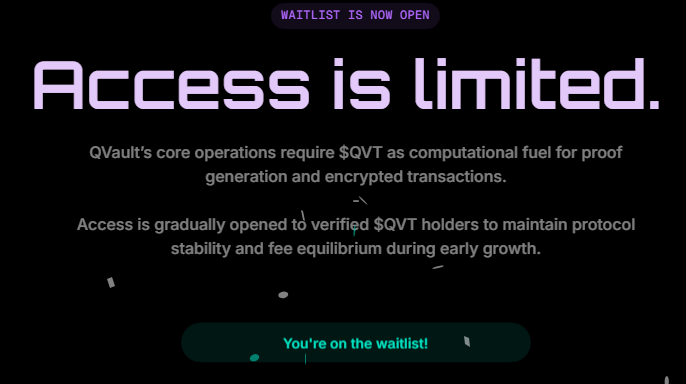
QVault is a quantum-secure protocol designed to protect transactions and proofs with physics-backed security. Its native utility token, $QVT, powers every cryptographic operation, ensuring privacy remains scalable, verifiable, and resistant to quantum attacks. Access is gradually opened to verified $QVT holders to maintain stability and fee equilibrium during early growth.
QVault — Protocol Overview
- Core Operations: $QVT fuels proof generation and encrypted transactions
- Access: Gradually opened to verified $QVT holders
- Focus: Quantum-resistant privacy and verifiable cryptography
- Protocol Layers: Quantum Infrastructure + $QVT Utility Layer
- Network: Anchored on Solana’s ledger for proof authenticity
Platform & $QVT Token Utility
- Computational Value: $QVT fuels zk-proofs, PQC signatures, entropy validations
- Proof Economy: Validators earn $QVT for verifying proofs; users pay micro-fees for private transactions
- Entropy Access: Quantum randomness sourced via oracles requires $QVT payments
- Oracle Integrity: Entropy nodes stake $QVT to distribute randomness securely
- Governance: $QVT holders vote on PQC algorithm upgrades, oracle integrations, and R&D funding
Growth Outlook & How to Participate
Participation:
- Acquire $QVT tokens to gain verified access
- Use $QVT for private, quantum-shielded transactions
- Stake $QVT to operate entropy nodes and maintain oracle integrity
- Engage in governance by voting on protocol upgrades and integrations
Outlook: As post-quantum cryptography standards evolve, QVault positions $QVT as a core utility token powering scalable privacy, randomness services, and governance. Demand loops from entropy access and proof verification create sustainable token utility beyond speculation.
Quick Summary
– QVault is a quantum-secure protocol powered by the $QVT utility token.
– $QVT represents computational value, fueling proofs, encrypted transactions, entropy access, and governance.
– Validators, users, and developers all rely on $QVT to maintain privacy and verifiability.
– With governance mechanisms and continuous demand loops, QVault aims to evolve alongside post-quantum standards.
Q&A — QVault Explained
Q: What is $QVT?
A: $QVT is the native utility token of QVault, powering cryptographic operations and quantum-secure transactions.
Q: How does $QVT differ from speculative tokens?
A: Unlike speculative assets, $QVT represents computational value, fueling zk-proofs, entropy, and governance.
Q: What is the Proof Economy?
A: Validators earn $QVT for verifying proofs, while users pay micro-fees to execute private transactions.
Q: How is randomness secured?
A: Quantum entropy oracles provide true randomness; access requires $QVT payments and staking.
Q: What role do $QVT holders play in governance?
A: Holders vote on PQC upgrades, oracle integrations, and ecosystem R&D, shaping the protocol’s evolution.