Project Overview

High‑frequency trading in crypto requires infrastructure that can deliver deterministic latency and seamless interoperability.
edgeX Exchange introduces a new architecture with its Spot Trading Beta, supporting ETH as the first native asset. With edgeVM and edgeEVM running in parallel, edgeX combines near‑native execution speed with full Ethereum compatibility, positioning itself as a next‑generation trading platform for both professional traders and DeFi developers.
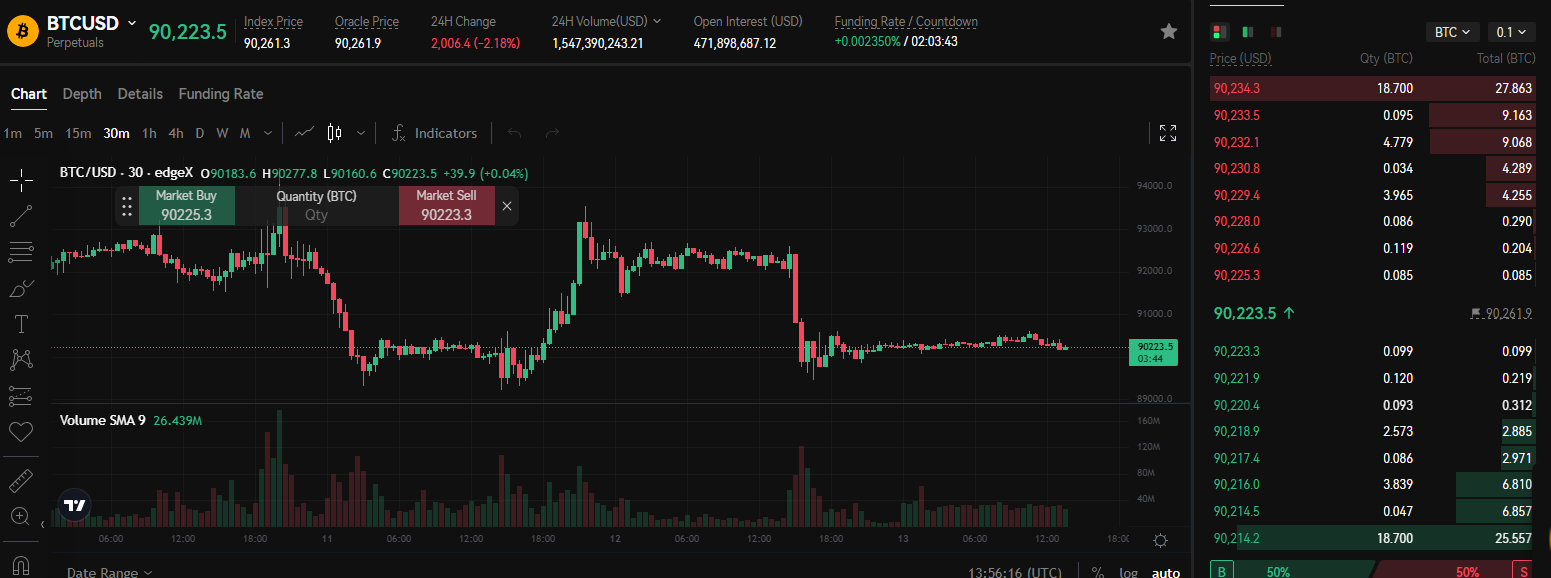
edgeX Exchange — Project Specification
Core Fundamentals
- Spot Trading Beta: Register. ETH supported for deposits, withdrawals, and trading.
- Platforms: Available on both web and mobile apps.
- edgeVM: Minimalist execution environment for high‑frequency financial tasks (matching engine, risk management, liquidation).
- Performance: Compiles trading logic into WebAssembly (WASM), leveraging Arbitrum Stylus for near‑native execution speeds.
- Dedicated Bandwidth: Protected execution context ensures deterministic latency, immune to generalized DeFi congestion.
Compatibility Layer
- edgeEVM: Fully conforming Ethereum Virtual Machine for interoperability.
- DeFi Logic: Supports ERC‑20/721 issuance, DAO governance, and treasury management.
- Developer Experience: Seamless composability with Solidity contracts and tooling (Hardhat, Foundry).
Extensibility
- VM Actors: Modular framework for secure, future‑proof extensibility.
- Allows integration of new modules without disrupting trading core or compatibility runtime.
Investment Drivers
Major Influences
- High‑frequency trading demand in crypto markets.
- Deterministic latency and near‑native execution speeds via WASM.
- Full Ethereum compatibility ensures developer adoption and DeFi composability.
- Modular extensibility framework supports long‑term scalability.
- ETH as first supported asset builds liquidity foundation.
Risks & Considerations
- Beta stage may expose technical or liquidity challenges.
- Competition from established exchanges with larger user bases.
- Adoption depends on developer trust in edgeVM and edgeEVM architecture.
edgeX Exchange — Native Token (EDGX)
Core details
- Token symbol: EDGX
- Role: Native utility and governance token of the edgeX ecosystem.
- Functions: Liquidity incentives, fee discounts, staking rewards, and governance participation.
- Blockchain context: Anchors the dual‑VM architecture (edgeVM for high‑frequency trading, edgeEVM for Ethereum compatibility).
Adoption & importance
- Liquidity backbone: Central to edgeX’s “Liquidity for All” initiative.
- Developer incentives: Supports grants, hackathons, and ecosystem growth.
- Interoperability: Works seamlessly with ERC‑20 standards via edgeEVM, ensuring DeFi composability.
Risks & considerations
- Beta stage: Spot trading is still in testing, so token utility is early‑phase.
- Competition: Must differentiate against established exchange tokens like BNB, OKB, and UNI.
- Adoption dependency: Long‑term value depends on trader migration and developer trust in edgeX’s architecture.
Summary
EDGX is the native token of edgeX Exchange, powering liquidity programs, trading rewards, and governance.
It binds the dual‑VM architecture and positions edgeX as a scalable, high‑performance trading platform.
As adoption grows beyond the Spot Trading Beta, EDGX’s role will be critical in driving liquidity and developer participation.
Summary
edgeX Exchange is building a next‑generation trading platform with its Spot Trading Beta live, supporting ETH deposits and trades. Its bifurcated runtime — edgeVM for high‑frequency execution and edgeEVM for Ethereum compatibility — delivers both speed and interoperability. With modular extensibility and deterministic latency, edgeX positions itself as a scalable solution for liquidity and developer adoption in the evolving DeFi landscape.
Questions & Answers
Q: What is edgeX Exchange?
A: A next‑generation crypto trading platform with Spot Trading Beta live, supporting ETH.
Q: What makes edgeX unique?
A: Its bifurcated runtime: edgeVM for high‑frequency execution and edgeEVM for Ethereum compatibility.
Q: How does edgeVM improve performance?
A: By compiling trading logic into WASM, eliminating EVM overhead, and ensuring deterministic latency.
Q: What assets are supported now?
A: ETH is the first native asset, with deposits, withdrawals, and spot trading available.
Q: What risks exist?
A: Beta stage challenges, competition from established exchanges, and adoption dependency on developer trust.