Datagram. The Decentralized AI Network Replacing the Cloud

Introduction
Datagram is building one of the most ambitious infrastructures in the decentralized internet — an AI-native DePIN protocol designed to handle real-time applications, AI compute, gaming environments, and edge data routing without relying on centralized cloud services.
Now live with its Alpha Testnet, Datagram opens its early ecosystem to developers and DePIN enthusiasts.
1. What Is Datagram?
Datagram positions itself as a next-generation decentralized network optimized for AI workloads and real-time communication. Unlike traditional Web2 cloud platforms (AWS, GCP, Azure), Datagram creates a distributed mesh of independent browser nodes and validators — making it ideal for:
- ⚡ Real-time applications
- 🤖 AI agents and model deployment
- 🎮 Multiplayer gaming
- 🌍 Edge computing across local nodes
Its architecture eliminates the need for centralized data centers, replacing them with lightweight, scalable browser validators through a Chrome extension and other integrations.
2. Key Features of Datagram
🔹 2.1 AI-Native by Design
Datagram is optimized for AI/ML workloads. It supports distributed computation by routing tasks through a decentralized validator layer.
🔹 2.2 DePIN Architecture
Instead of relying on central servers, Datagram runs on Distributed Physical Infrastructure Networks (DePIN). This allows individuals to contribute computing power via browser-based nodes.
🔹 2.3 Real-Time Focus
Its network is latency-optimized — suitable for messaging, real-time multiplayer games, and AI inferencing. Datagram promises seamless edge connectivity.
🔹 2.4 Chrome Extension Validator
Anyone can participate in the network using the Datagram browser validator, earning early rewards and contributing to the testnet.
3. Alpha Testnet — Join the Early Network
Datagram is currently running its Alpha Testnet, allowing early users to participate, validate, and prepare for the network’s next phase.
✅ How to Join the Alpha Testnet
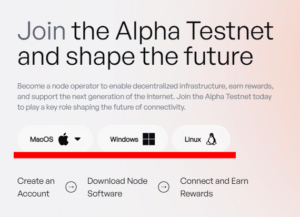
- Visit the official site: https://www.datagram.network/alpha-testnet
- Choose your platform and download the software. Create an unique username
- Install and Run the validator to start contributing resources
- Track logs and reward data from your validator dashboard
- Software Node operator is in early stage. Might freezes and bugs. Keep running
- Submit your details via request participation form: (https://docs.google.com/forms/d/e/1FAIpQLSevC3QjAx4xdNysKoRtCSR_5cAUtVBhoNu3XoCrQBIOYVQN8A/viewform?pli=1)
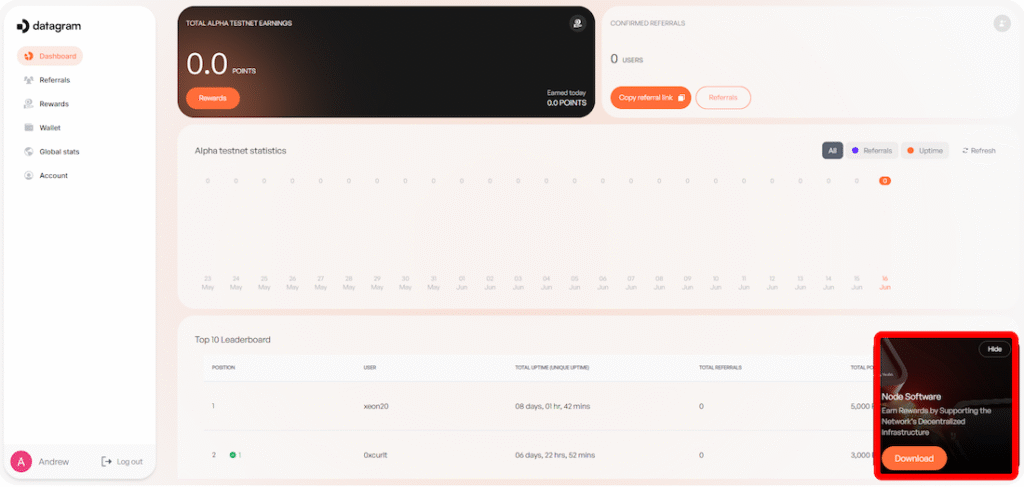
This early phase helps Datagram gather stress-test metrics, distribute reputation points, and prepare for its token economy.
4. Token Information
As of now, Datagram has not yet launched a public token. However, given its early DePIN + AI strategy and current Alpha phase, it’s expected to integrate a native token for:
- Rewarding validators
- Powering AI tasks
- On-chain coordination of compute and bandwidth
📌 Anticipated TGE: There is no official date, but testnet participants may be eligible for future token-based rewards. Watch for announcements via their X page and Discord.
5. Strategic Importance in Web3 and AI
Datagram is part of the growing AI + DePIN sector, similar in vision to projects like Grass, Nos, and DePINed — but with a more technical, real-time-first approach.
It sits at the intersection of:
- AI Agent automation
- Edge computing
- Consumer-powered networks
- Web3 cloud alternatives
Its emphasis on light validator nodes gives it an edge in adoption compared to GPU-heavy platforms.
Conclusion
Datagram is not just another browser miner — it’s a real-time infrastructure protocol with utility across AI, DeFi, and gaming. With its Alpha Testnet live and a token likely on the horizon, now is the time to explore and participate.
The future of compute is decentralized — and Datagram could be the network powering it.