Tokenized Stocks: Strategic Entry Points as S&P 500 and Dow Jones Move Toward On-Chain Index Licensing
The tokenization of traditional equities is entering a new phase of institutional legitimacy. According to recent reports, S&P 500 and Dow Jones are actively negotiating with major exchanges, custodians, and DeFi protocols to license and list tokenized versions of their benchmark indices. This signals a pivotal shift in how capital markets may integrate blockchain infrastructure—not just for settlement efficiency, but for direct investor access to fractionalized, programmable equity exposure.
What Is Stock Tokenization?
Stock tokenization refers to the process of issuing blockchain-based representations of traditional equities. These tokens mirror the price and performance of underlying stocks or ETFs and are often backed 1:1 by custodial holdings. Tokenized stocks can be traded 24/7, integrated into DeFi protocols, and accessed globally without intermediaries. They offer fractional ownership, instant settlement, and programmable compliance—features that traditional equities cannot match without blockchain rails.
Understanding the S&P 500 and Dow Jones
- S&P 500: A market-cap-weighted index tracking 500 of the largest publicly traded companies in the U.S. It is widely regarded as the most accurate gauge of U.S. equity performance. Managed by S&P Dow Jones Indices, it includes leaders across tech, finance, healthcare, and consumer sectors.
- Dow Jones Industrial Average (DJIA): A price-weighted index of 30 blue-chip U.S. companies. Unlike the S&P 500, the DJIA focuses on industrial and legacy firms with long-standing market influence. It is one of the oldest and most recognized indices globally.
The licensing of tokenized versions of these indices would allow DeFi platforms and global exchanges to offer synthetic exposure to U.S. equities, potentially bypassing traditional brokerage infrastructure.
Top 5 Stocks Likely to Be Tokenized First
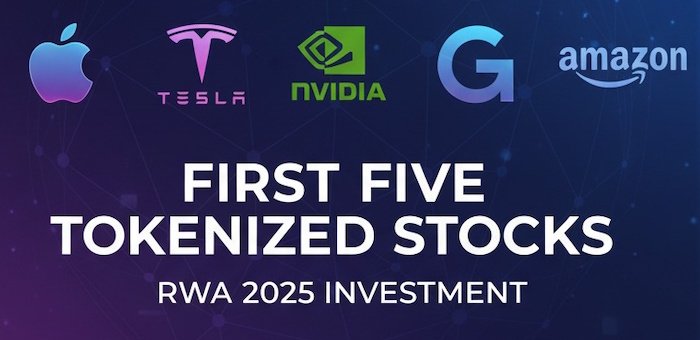
Based on current tokenization trends and market capitalization within the S&P 500 and Dow Jones, the following stocks are positioned as early candidates for tokenized deployment:
| Stock | Ticker | Sector | Rationale |
|---|---|---|---|
| Apple Inc. | AAPL | Technology | High liquidity, global demand, already tokenized on multiple platforms |
| Tesla Inc. | TSLA | Automotive/Tech | Volatile price action, strong retail interest, active DeFi integration |
| NVIDIA Corp. | NVDA | Semiconductors | AI-driven growth, top S&P performer, tokenized ETF exposure |
| Alphabet Inc. | GOOGL | Technology | Core index component, high trading volume, token-ready infrastructure |
| Amazon.com Inc. | AMZN | E-commerce | Global retail exposure, fractional demand, already tokenized |
These stocks are not only among the most capitalized in the S&P 500 but also exhibit strong retail and institutional interest, making them ideal candidates for tokenized replication. Platforms such as xStock and PreStocks have already begun listing synthetic versions of these equities.
Strategic Implications for Investors
Tokenized stocks offer several strategic advantages:
- Global Access: Investors outside the U.S. can gain exposure to American equities without brokerage restrictions.
- Fractional Ownership: High-priced stocks like Amazon and NVIDIA become accessible to smaller portfolios.
- DeFi Integration: Tokenized stocks can be used as collateral, yield-bearing assets, or governance tools within decentralized finance.
- 24/7 Trading: Unlike traditional markets, tokenized equities trade around the clock, enabling real-time portfolio rebalancing.
However, regulatory clarity remains a key barrier. The involvement of S&P and Dow Jones in licensing discussions suggests that compliant frameworks may soon emerge, paving the way for broader institutional adoption.
Conclusion
The convergence of traditional equity indices with blockchain infrastructure marks a new era in capital markets. As S&P 500 and Dow Jones move toward licensing tokenized versions of their benchmarks, investors should prepare for a landscape where stocks are not just traded—but programmed, fractionalized, and globally accessible. Apple, Tesla, NVIDIA, Alphabet, and Amazon are likely to lead this transition, offering strategic entry points for portfolios seeking exposure to tokenized real-world assets.