Intro — Gonka Network ($GNK)

Gonka introduces a decentralized infrastructure layer focused on high-efficiency AI computation. Unlike traditional cloud providers where idle capacity and overhead reduce efficiency, Gonka is designed to allocate nearly 100% of computational power toward meaningful AI workloads such as training and inference.
The protocol restructures the relationship between compute providers and developers, forming a system where performance, contribution, and resource utilization define influence rather than capital ownership.
Core Proposition
Gonka optimizes distributed compute by aligning incentives between developers and hardware providers. The protocol reduces costs while maintaining transparency and censorship resistance. A compute-native economy replaces capital dominance with verifiable contribution.
Developer Layer
Gonka enables developers to deploy AI applications without relying on centralized providers.
- Cost model based on processed AI tokens ensures precise billing
- Early-stage subsidies reduce costs by up to 90%
- API integration mirrors centralized platforms, minimizing onboarding friction
This framework allows rapid deployment while maintaining cost efficiency and operational independence.
Host Economy
Gonka shifts economic power toward hardware providers through a Proof of Compute (PoC) model.
- 84% of total supply allocated to Hosts (840M GNK)
- Rewards distributed through epoch emissions
- Additional income via Work Coins from developer demand
Voting power and governance influence are directly tied to verified computational output rather than token holdings.
Tokenomics Overview
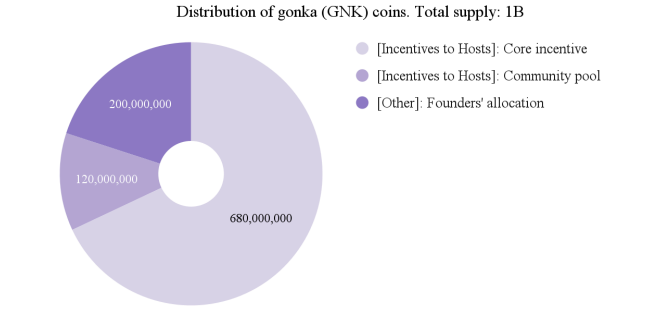
The total supply of GNK is capped at 1 billion tokens.
- 84% allocated to Hosts and network rewards
- Remaining allocation supports ecosystem development and growth
- Emission model tied to compute contribution and network activity
This structure prioritizes long-term infrastructure expansion over speculative distribution.
GNK Token — Value, Status, and Potential
Current Status
GNK is currently not listed on public exchanges. Distribution occurs through network participation, including hosting compute resources and bounty programs. Current price is 0.44$
Utility Layer
GNK functions as the core economic unit:
- Pricing compute resources
- Rewarding Hosts for verified work
- Enabling governance via PoC-weighted voting
Price Formation
At the current stage, GNK has no fixed market price. Its implied valuation is derived from:
- Cost savings compared to centralized AI compute providers
- Demand for decentralized inference and training workloads
- Network growth and utilization metrics
Price Prediction & Potential
Given the early-stage positioning, GNK represents a pre-market asset with asymmetric upside tied to infrastructure adoption.
If Gonka captures a share of the decentralized AI compute sector, valuation expansion may follow a trajectory similar to early infrastructure tokens.
Key drivers include:
- Adoption by AI developers seeking cost-efficient alternatives
- Scaling of host network capacity
- Transition to exchange listings and open market liquidity
- Easily could hit 2.5$ in the middle of the summer
Early contributors benefit from lower implied valuation and higher emission rewards before full market discovery.
Participation Strategy — Gonka
Early Infrastructure Entry
Deploying compute resources early maximizes exposure to high emission phases and lower competition.
Compute Efficiency
Optimizing hardware utilization directly impacts rewards under the PoC model.
Developer Alignment
Tracking demand for inference workloads allows Hosts to align capacity with high-value tasks.
Long-Term Positioning
Accumulating GNK prior to exchange listing provides exposure to potential price discovery events.
Earning GNK — Mining & Reward Mechanisms
GNK distribution is fundamentally tied to active participation in the network, with rewards allocated through computational contribution rather than passive holding.
Proof of Compute (PoC)
The primary mechanism for earning GNK is through Proof of Compute, where Hosts contribute hardware resources to process AI workloads.
- Run a node and connect compute resources to the network
- Process training and inference tasks for developers
- Receive GNK rewards based on verified output and uptime
Epoch Rewards
GNK tokens are minted and distributed across defined epochs.
- Higher performance and consistent availability increase reward share
- Early-stage participants benefit from higher emission rates
Work Coins from Developers
In addition to protocol emissions, Hosts receive direct payments from developers.
- Earn Work Coins for executing inference tasks
- Supplement GNK rewards with real demand-driven income
Bounty Programs
Additional GNK allocation is available through ecosystem incentives.
- Participate in network growth campaigns and testing phases
- Earn GNK for contributing to development, validation, or community tasks
Access Strategy
Since GNK is not yet listed on exchanges, accumulation depends entirely on participation.
- Deploy hardware early to maximize emissions
- Maintain high uptime and efficient compute allocation
- Engage in bounty and ecosystem programs for additional rewards
This model ensures that token distribution directly reflects real contribution, reinforcing Gonka’s compute-native economic structure.
Outro — Summary
Gonka establishes a compute-native economy where AI infrastructure is decentralized, efficient, and directly tied to contribution. By prioritizing hardware providers and aligning incentives through GNK, the network creates a scalable alternative to centralized cloud systems. With its token still in the pre-market phase, Gonka represents an early-stage infrastructure play where value is expected to emerge alongside real adoption and compute demand.
Gonka Network GNK Token Overview