KBBB Token Arbitrage Strategy: How to Profit from Price Discrepancies Between MEXC and XT.com

Introduction
KBBB is a highly volatile token currently listed on both MEXC and XT.com exchanges. Its liquidity is moderate, and frequent price desynchronizations create recurring arbitrage windows. This guide outlines a rotation-based arbitrage strategy, built to exploit these short-term discrepancies. The method is designed for fast execution, cross-exchange coordination, and risk-minimized profit cycles.
Strategy Overview
The core idea is to rotate KBBB between two exchanges based on detected spread margins — buying low on one exchange and selling high on the other. This approach is cycle-based and benefits from frequent volatility bursts typical of low-cap tokens like KBBB.
We will use the following components:
-
Spot market trading only (no leverage)
-
Two exchange accounts: MEXC and XT.com
-
Manual or semi-automated monitoring of KBBB/USDT pair
-
Fast transfer of KBBB on-chain via token address:
B9gnz4YLhxqzTkfakaVviZe5WfTLY4MqGmWhaxF8BrFk
Phase 1: Preparation and Infrastructure
1. Create and Verify Accounts
- Join XT and get special income bonus. Join MEXC and get a free trading spot balace.
-
MEXC and XT accounts must be fully verified (KYC completed) to prevent withdrawal restrictions.
-
Whitelist your own KBBB wallet address on both platforms to accelerate withdrawals.
2. Fund the Strategy
-
Split your initial capital 50/50:
-
50% in USDT on MEXC
-
50% in KBBB tokens on XT.com
-
This enables you to act from either side of the arbitrage window immediately, without waiting for blockchain confirmations.
3. Set Up Tracking Tools
-
Create TradingView alerts or use price bots to monitor KBBB/USDT on both exchanges.
-
Optional: use a spreadsheet that calculates spread percentage automatically.
Phase 2: Execution Logic
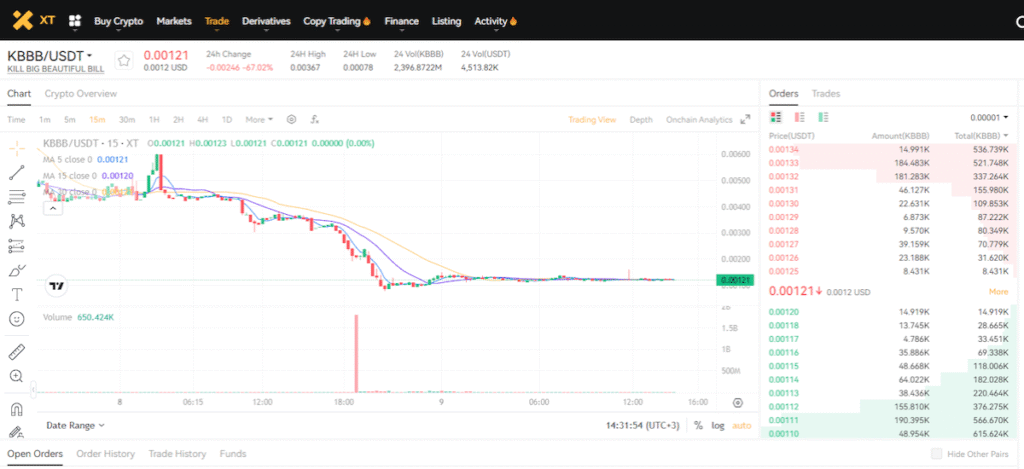
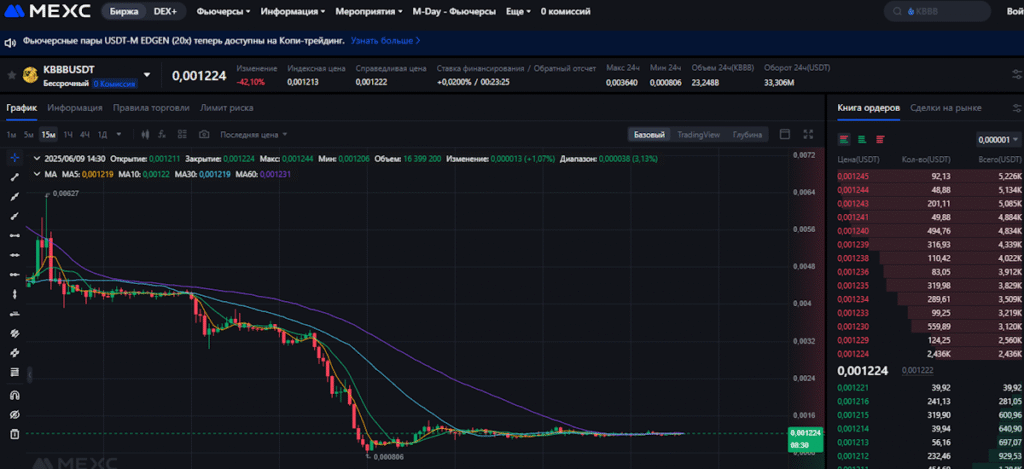
Arbitrage Signal Conditions
Initiate a trade when the price gap exceeds 2.5%, taking into account:
-
Trading fees (~0.1%–0.2% per side)
-
KBBB withdrawal fee (check live rate per exchange)
-
USDT volatility (rare, but can affect timing)
Trigger Example:
-
MEXC: KBBB = 0.0385 USDT
-
XT.com: KBBB = 0.0415 USDT
→ Spread: +7.7%
→ Net potential (after 1% total fees): ~6.7% ROI
Phase 3: Rotation Execution
Scenario A: Buy Low on MEXC → Sell High on XT
-
Buy KBBB on MEXC with USDT
-
Withdraw KBBB to your on-chain wallet
-
Deposit KBBB to XT.com
-
Sell KBBB on XT for USDT
-
(Optional) Transfer USDT back to MEXC to restart cycle
Scenario B: Reverse Flow if Price Inverts
-
Buy KBBB on XT.com
-
Transfer to MEXC
-
Sell KBBB on MEXC
-
Rebalance USDT and rotate again
Tactical Enhancements
Pre-funding Loop
Maintain:
-
A floating USDT reserve on both exchanges
-
A floating KBBB reserve on both exchanges
This enables instant swaps when windows appear, without waiting for transfer delays.
Use Small Increments
Avoid full-size transfers per cycle:
-
Trade in smaller lots (e.g., $200–$500 per cycle)
-
This reduces slippage and allows faster reaction to new spreads
Chain-Specific Observations
-
KBBB may use Solana or other fast L1; confirm with token contract (
B9gnz...) and test transfer speeds -
Always track network congestion before initiating withdrawal to avoid timing risks
Risk Management
-
Withdrawal delay: Some exchanges may queue token withdrawals for up to 10–30 minutes. Time-sensitive trades may expire.
-
Slippage: Thin liquidity can trigger slippage when using large market orders. Use limit orders when possible.
-
Token liquidity: Market depth can vary hourly — monitor bid/ask wall density before executing.
Scaling the Strategy
-
Start with small daily cycles to build confidence and test spreads
-
Track ROI per trade to identify optimal timeframes (e.g., high volume hours)
-
Use multiple sub-accounts for parallel operations, especially if arbitrage windows persist
-
Consider scripting basic price monitors using APIs or bots (e.g., using Python with ccxt)
Summary
Arbitraging the KBBB token between MEXC and XT.com offers a lucrative short-cycle trading opportunity. The volatility of KBBB, paired with inconsistent price synchronization, enables regular spread captures above 3–5%, often within short timeframes. With proper setup, funding, and timing discipline, this strategy can yield daily returns for advanced users prepared to manage the operational complexity and transfer risk.