Sentient Blockchain Overview
Blockchain is designed as infrastructure for the Open AI Economy, aiming to decentralize artificial intelligence development and ownership. By combining blockchain governance, cryptographic verification, and tokenized incentives, Sentient addresses structural issues in the AI industry such as monopolization, lack of transparency, and limited financial incentives for open‑source contributors. Its mission is to establish an Open AGI Economy where models, datasets, and computational resources interact through decentralized coordination rather than corporate control.
Concept and Problem Statement
AI development today is dominated by large corporations controlling proprietary models and APIs.
This centralization creates risks of censorship, monopolistic pricing, and reduced transparency.
Sentient proposes a decentralized alternative where independent developers can deploy open models, preserve ownership rights, and receive automated compensation via smart contracts.
The framework solves two key problems: lack of incentives for open‑source AI and dependence on closed corporate platforms.
Technical Architecture
Sentient’s architecture integrates two layers:
- Blockchain Layer: Manages governance, token transactions, and ownership verification through DAO mechanisms.
- AI Pipeline: Handles data curation, model training, and validation to ensure reliability and alignment.
Together, these layers create a decentralized environment for building, deploying, and monetizing AI artifacts.
Core Technologies
- OML Framework: Open, Monetizable, Loyal — ensuring transparency, automated payments, and community governance.
- Model Fingerprinting: Cryptographic embedding to detect unauthorized commercial use of open models.
- ROMA (Recursive Open Meta Agents): Multi‑agent system architecture that decomposes tasks into subtasks for reliable outputs.
Ecosystem Structure
The ecosystem is coordinated through GRID (Global Repository of Intelligence & Research Directory).
GRID connects models, agents, datasets, and computing resources into a modular network.
End‑users access these components via applications like Sentient Chat, enabling real‑time data analysis and open model interaction.
Token Economy, Metrics and Price Prediction
- SENT Token: Used for payments, staking, and financial coordination.
- Current price: 0.022$ (has 10x potential, easy hit 0.2 in the summer)
- Supply: ~34.36 billion tokens, with moderate inflation to reward participants.
- Revenue: Generated via transaction fees distributed among developers, data providers, and infrastructure operators.
Development and Strategic Direction
Sentient launched after securing venture funding and releasing a test network.
Milestones include the open AI network, consumer applications, and token distribution mechanisms.
Future plans involve deeper decentralization, expansion of multi‑agent infrastructure, and enterprise integrations.
The long‑term vision is to establish Sentient as a universal coordination layer for decentralized AI systems.
GRID — Global Repository of Intelligence & Research Directory
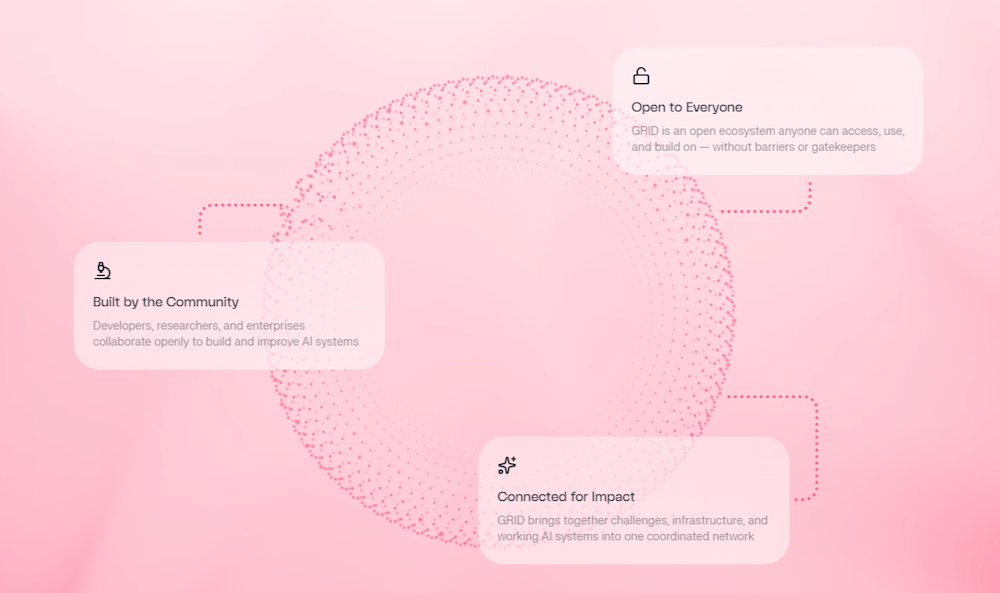
GRID is the backbone of Sentient Blockchain, functioning as a decentralized directory and coordination system for AI components.
Instead of relying on a single monolithic model, GRID orchestrates multiple specialized modules — models, agents, datasets, and compute nodes — to produce intelligent outcomes.
This modular approach ensures scalability, transparency, and resilience, while allowing contributors to monetize their work through automated blockchain payments.
Summary
Sentient Blockchain represents a bold attempt to merge decentralized economics with open AI innovation. By embedding governance, automated payments, and cryptographic verification into its infrastructure, Sentient creates a sustainable market for open‑source AI. If widely adopted, it could reduce dependence on centralized providers and foster a collaborative ecosystem where developers, data contributors, and users share ownership of the Open AGI Economy.
